A cluttered entryway often starts with shoes piling up near the front door. Thoughtful entryway shoe storage can turn this space into an organized entry point.
Benches and cabinets offer seating alongside concealed storage, keeping mornings smoother and floors noticeably clearer throughout the week.
From compact racks to freestanding towers, these twenty ideas address nearly every household’s footwear organization and space needs.
In this post you’ll find:
- Discover space-saving benches that combine seating with hidden shoe storage.
- Learn how stackable shelves adapt to growing shoe collections easily.
- Explore enclosed cabinets that keep footwear tidy and dust-free.
- See how baskets and bins organize shoes by type or season.
- Find vertical racks designed to maximize narrow entryway floor space.
- Uncover clever cubbies and drawers that hide clutter completely away.
This post contains affiliate links. As an Amazon Associate I earn from qualifying purchases, at no extra cost to you.
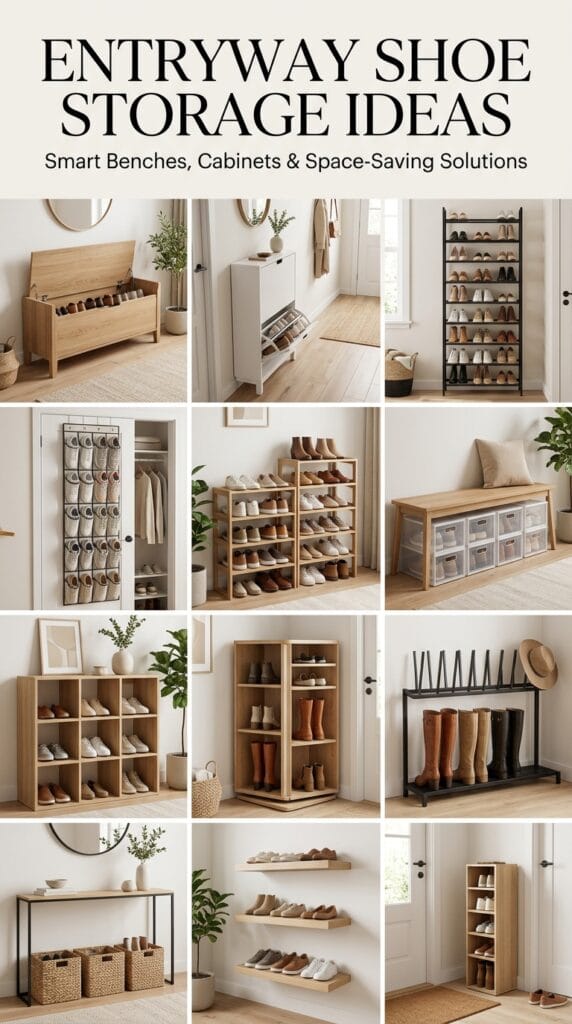
01. Shoe Storage Bench
A narrow entryway rarely has room for extra seating and storage separately. Combining both functions solves that everyday limitation in one simple step.
Shoe storage bench tucks under a coat rack or window, offering a comfortable spot to sit while putting on shoes.
For broader creative approaches to shoe storage, a bench that pairs seating with concealed cubbies is often appreciated by families.
02. Shoe Cabinet
Visual clutter near the front door can make an entire home feel disorganized. A closed cabinet solves this by hiding footwear entirely from view.
The enclosed shoe cabinet holds several pairs while keeping the entryway looking clean and uncluttered.
Its slim profile fits against narrow walls, making it practical for apartments and smaller entry spaces alike.
03. Vertical Shoe Rack
Floor space is often the biggest constraint in a small entryway. Building upward instead of outward solves this common storage challenge effectively.
A vertical shoe rack stacks multiple tiers into a narrow footprint, accommodating several pairs without crowding the floor.
This design works especially well in mudrooms or tight hallway corners near a front door.
04. Over-the-Door Shoe Organizer
Some entryways simply lack floor space for additional furniture. Using an existing door surface addresses this limitation without adding bulk.
The over-the-door shoe organizer hangs directly on a closet or entry door, holding numerous pairs in individual pockets.
Renters and small-space dwellers often favor this option since it requires no permanent installation or drilling.
05. Stackable Shoe Shelves
Growing shoe collections can quickly overwhelm a fixed storage setup. Flexible, expandable shelving addresses this ongoing organizational need.
Stackable shoe shelves can be added or removed as household footwear needs change over time.
Their modular design suits closets, mudrooms, or open entryway corners where storage requirements shift seasonally throughout the year.
06. Clear Storage Bins
Finding a specific pair of shoes can be frustrating when everything is hidden away. Transparent storage solves this everyday visibility problem.
Clear storage bins let household members see contents instantly without opening every container.
Stacked neatly on a shelf or under a bench, these bins keep seasonal or occasional shoes accessible yet contained.
07. Shoe Cubby Organizer
An open entryway can quickly become visually chaotic with scattered shoes. Defined individual compartments address this everyday disorganization.
The shoe cubby organizer assigns each pair its own designated space, encouraging consistent daily habits.
This structure works particularly well for larger households where multiple family members share one entry area.
08. Rotating Shoe Rack
Awkward corners in an entryway often go unused because standard shelving does not fit well. A rotating design solves this spatial challenge.
The rotating shoe rack spins to reveal each tier, making every pair easy to reach without removing others.
Compact and efficient, it suits narrow closets or tucked-away entry corners with limited access.
09. Slim Entryway Shoe Cabinet
Tight hallways rarely accommodate bulky furniture without disrupting foot traffic. A slim-profile cabinet resolves this everyday spatial conflict.
Fitting against narrow walls, the slim entryway shoe cabinet conceals footwear while preserving walking space near the door.
Readers comparing compact layouts may also find smart shoe storage solutions for tight spaces useful for further planning.
10. Boot Storage Rack
Seasonal boots present a unique organizational challenge due to their height and shape. A dedicated rack accommodates this difference effectively.
The boot storage rack uses angled slots to hold boots upright without letting them slump or lose shape.
Placed near a mudroom entrance, it keeps wet or muddy footwear separate from everyday shoes.
11. Shoe Storage Baskets
Casual, grab-and-go footwear does not always need rigid compartments. Soft, flexible baskets address this more relaxed storage scenario.
Woven or fabric shoe storage baskets sit easily on open shelving, corralling loose pairs without a formal system.
Their casual texture also adds warmth to an entryway while keeping shoes contained and tidy.
12. Under-Bench Shoe Trays
Many entryway benches leave the space beneath them entirely unused. Fitted trays make this overlooked area genuinely functional.
Under-bench shoe trays slide beneath seating, catching dirt and moisture while keeping shoes organized out of sight.
This setup suits busy households where shoes are removed quickly upon entering the home.
13. Wall-Mounted Shoe Shelves
Floor clutter becomes a persistent issue in entryways with heavy foot traffic. Elevating storage onto the wall addresses this recurring problem.
Wall-mounted shoe shelves keep pairs off the ground entirely, simplifying floor cleaning and reducing tripping hazards.
Installed in a row, they create a tidy, gallery-like display near the front entrance.
14. Expandable Shoe Rack
Household shoe collections rarely stay the same size throughout the year. An adjustable rack accommodates this natural fluctuation.
The expandable shoe rack widens or narrows to fit different closet or entryway dimensions as needed.
This flexibility makes it a practical long-term solution for households anticipating future storage changes and needs.
15. Shoe Storage Ottoman
Some entryways serve double duty as a sitting area and drop zone. A storage ottoman addresses both functions in one compact piece.
Underneath its cushioned top, the shoe storage ottoman hides several pairs while offering a comfortable place to sit.
This dual-purpose furniture suits smaller homes where every piece needs to serve more than one role.
16. Label Systems for Shoe Bins
Locating specific shoes within multiple bins can slow down a busy morning routine. Clear labeling resolves this recurring frustration quickly.
Label systems mark each bin by shoe type, season, or family member, speeding up daily selection.
Consistent labeling also helps children and guests return shoes to the correct spot independently.
17. Mudroom Shoe Organizer
Homes with mudrooms often deal with dirt, moisture, and mixed footwear all at once. A dedicated organizer manages this specific challenge.
The mudroom shoe organizer combines slots, hooks, and trays to handle boots, sneakers, and sandals together.
Positioned near a back or side entrance, it keeps outdoor mess contained before it spreads further inside.
18. Slide-Out Shoe Drawers
Closed cabinets can make it difficult to see shoes stored deep inside. Sliding mechanisms address this accessibility concern directly.
Slide-out shoe drawers pull forward smoothly, revealing every pair without requiring anyone to kneel or dig around.
This design suits taller cabinets where reaching the back shelf would otherwise prove inconvenient.
19. Freestanding Shoe Tower
Entryways without built-in closets still need a dedicated footwear solution. A standalone tower fills this gap without renovation.
The freestanding shoe tower stacks several tiers vertically, offering ample capacity within a small footprint.
Its mobility also allows the tower to be relocated easily if the household layout needs to change later.
20. Foldable Shoe Storage Cubes
Not every household needs permanent shoe storage furniture year-round. Collapsible options address this more flexible, temporary need.
Foldable shoe storage cubes fold flat when not in use, making them easy to store or transport.
They work well for renters, seasonal storage, or households that frequently rearrange their entryway layout.
Building an Entryway That Stays Organized
Consistent entryway shoe storage depends less on any single product and more on matching solutions to daily habits.
Combining benches, cabinets, and shoe storage solutions built for compact spaces creates a system that adapts as needs evolve.