Living in a studio apartment means every square foot counts. Smart studio apartment organization isn’t just about tidiness — it’s about creating systems that make a small space genuinely livable.
The right storage solutions can separate your sleeping zone from your workspace. They can keep clutter out of sight without sacrificing easy access to everyday items.
This guide covers 25 practical ideas suited to compact layouts, from floor-level storage to vertical wall systems.
In this post you’ll find:
- Vertical wall shelving systems that reclaim unused overhead space efficiently
- Closet organizers built for compact wardrobe systems with maximum hanging capacity
- Under-bed storage containers designed to hide seasonal and overflow items
- Over-door pocket organizers that turn blank door space into active storage
- Drawer organizers that bring structure to the kitchen, desk, and bedroom areas
- Stackable bins and labeled containers that maintain long-term organization habits
This post contains affiliate links. As an Amazon Associate I earn from qualifying purchases, at no extra cost to you.
01. Clear Storage Bins
Visibility is a real advantage in a small space. When every container shows its contents at a glance, you stop rummaging and start retrieving efficiently.
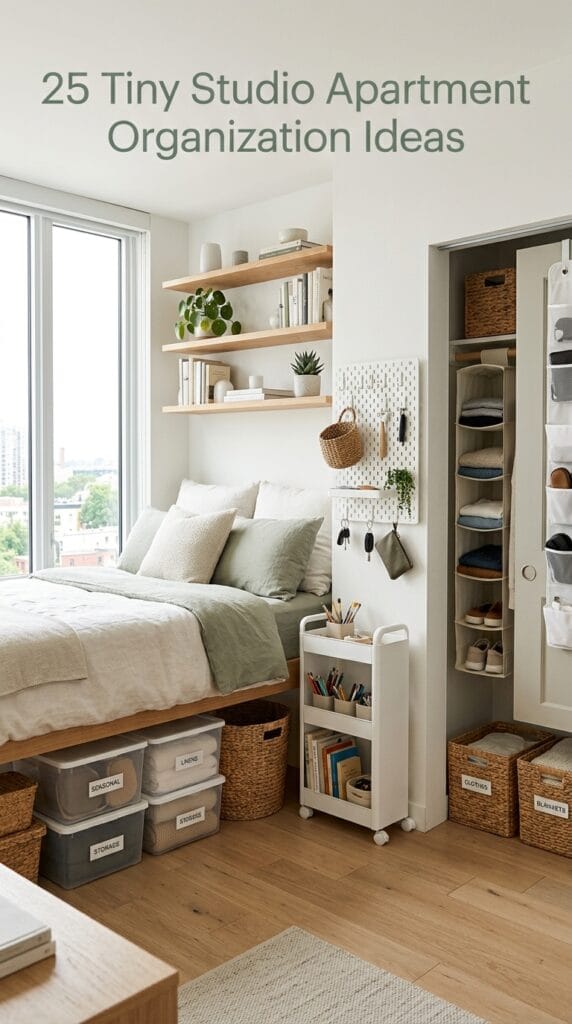
Clear storage bins work across nearly every zone in a studio — under the bed, on closet shelves, or stacked in a corner. Their uniform shape also makes stacking stable and neat.
For seasonal clothing or spare linens, these containers keep items dust-free without hiding them completely.
02. Floating Wall Shelves
Wall space is the most underused storage surface in a studio. Mounting shelves above furniture immediately adds storage without taking up any floor area.
Floating shelves suit living zones, kitchen walls, and bathroom areas equally. They can hold books, decorative baskets, or folded items depending on the room’s function.
Grouping shelves in columns or rows creates a structured storage wall that feels intentional rather than improvised.
03. Under-Bed Storage Containers
The space beneath a bed is one of the most valuable storage areas in any studio. Flat rolling containers slide in and out easily, making this zone genuinely functional rather than forgotten.
Low-profile bins with lids work well for off-season clothing, extra bedding, or shoes. Some designs include wheels for easier access daily.
Pairing two containers — one per side — can double the available capacity without adding visible bulk.
04. Drawer Organizers
Junk drawers happen fast in a studio apartment where every surface doubles as a landing zone. A drawer organizer divides interior space into dedicated compartments that keep categories separated.
These inserts come in modular grid formats, making them adaptable to kitchen utensil drawers, bedroom nightstands, or desk storage. Compartments prevent small items from shifting around.
Once in place, drawer organizers typically reduce retrieval time and eliminate the need to search through mixed contents.
05. Over-Door Pocket Organizers
Doors offer hidden storage potential that most studio layouts never use. An over-door pocket organizer mounts without tools and instantly creates rows of accessible compartments.
These work well on bathroom doors for toiletries, pantry doors for snacks or spices, and bedroom doors for accessories or small folded items. Fabric or clear-pocket versions suit different needs.
The storage gained doesn’t reduce floor space, making this solution especially suited to cramped layouts.
06. Stackable Storage Baskets
Texture and structure can coexist when storage baskets are chosen with a stackable design in mind. These containers move between rooms easily, making them flexible as routines change.
Woven or wire versions hold magazines, remote controls, throws, or pantry overflow, depending on placement. Stacking two or three vertically turns a corner into a compact shelving system.
Keeping bedroom storage low-profile and manageable pairs well with a basket system that stays within reach but off visible surfaces.
07. Closet Organizers
A studio closet often serves more functions at once — clothing, supplies, and overflow. A closet organizer adds tiered rods, shelves, and door pockets in one compact system.
Modular designs let you configure sections based on actual needs. Doubling the hanging rod for shorter garments roughly doubles clothing capacity.
Practical compact wardrobe storage strategies rely on this layered approach inside limited square footage.
08. Label Systems
Storage systems work long-term only when every household member — or just you — can locate items without hunting. Labels remove the guesswork from bins, baskets, drawers, and pantry containers alike.
Printed label sets with a handheld maker produce uniform tags that stick to most surfaces. Chalkboard labels allow updates as categories shift over time.
Consistent labeling also makes putting things away faster, which sustains organizational habits through regular routines.
09. Rolling Storage Carts
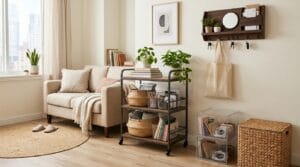
Mobility is an overlooked feature in small-space storage. A rolling cart moves between zones as needed — serving as a kitchen island, bathroom caddy, or bedside table depending on the moment.
Multi-tier carts with open shelves or drawers hold everything from craft supplies to toiletries. Metal wire versions add an industrial look while keeping contents visible.
Rolling carts tuck beside furniture or into corners when not actively in use.
10. Shelf Dividers
Open shelving looks clean only when items stay neatly upright. Shelf dividers keep folded clothing stacks, books, and baskets from toppling into one another over time.
Clip-on designs install without tools and adjust to different shelf depths. They work especially well in closets, linen storage, and open bookcases used for clothing.
Vertical divisions also create natural categories — giving each type of item a designated zone without requiring additional containers.
11. Shoe Storage Racks
Footwear creates fast clutter near entryways when there’s no dedicated system. A tiered shoe rack concentrates pairs into a compact vertical footprint that keeps the floor clear.
Adjustable multi-tier racks hold eight to sixteen pairs, depending on configuration. Slanted tiers display shoes at an angle, making selection faster without pulling everything out.
Space-efficient footwear storage solutions extend beyond the entryway into closets and under-bed zones as well.
12. Magnetic Strips and Wall-Mounted Organizers
Countertop space in a studio kitchen disappears fast. Mounting a magnetic strip or wall organizer along a backsplash keeps tools accessible without claiming any prep surface.
These systems hold kitchen knives, metal utensils, spice tins with magnetic bases, and small accessories. Some designs include hooks for hanging items of varying weights.
Wall mounting shifts storage off horizontal surfaces entirely, which matters most in compact cooking areas.
13. Vacuum Storage Bags
Bulky items like comforters, winter coats, and thick sweaters consume storage volume far out of proportion to how often they’re actually used. Vacuum storage bags compress these items to a fraction of their normal size.
Once sealed and compressed, the flat bags slide under a bed, onto a high shelf, or into a suitcase stored in a closet. Most bags reseal for repeated seasonal use.
This approach is particularly effective for rotating seasonal wardrobes in a studio without dedicated storage rooms.
14. Hanging Closet Organizers
Vertical hanging organizers use the rod space below hung garments to create shelf-style compartments for folded clothing, accessories, and shoes.
These fabric units attach directly to a closet rod with a hook, requiring no installation. Compartments stack six to twelve sections deep, turning unused hanging space into active storage.
They work well in smaller closets where floor-based drawer units don’t fit but additional folded storage is still needed.
15. Cabinet Door Organizers
The interior surface of cabinet doors is wasted space in most kitchens and bathrooms. A door-mounted organizer attaches to this surface and adds rows of bins or pocket slots for small items.
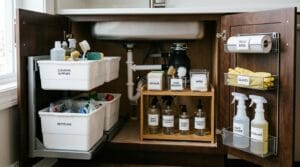
Under-sink cabinet doors hold cleaning supplies, extra sponges, or trash bags when outfitted with these organizers. Kitchen cabinet doors can store spices, foil rolls, or cutting boards.
This approach works without requiring any cabinet interior reconfiguration.
16. Pegboards
A pegboard turns any open wall section into a customizable storage grid. Hooks, shelves, bins, and holders all attach directly to the grid and rearrange without tools whenever needs change.
Studio kitchens use pegboards for cookware and utensils. Home office corners use them for cords, headphones, and supplies. Entryways mount them for bags, keys, and mail.
The modular format means one board can evolve alongside the changing functions of a compact living space.
17. Stackable Drawer Units
Freestanding drawer units create dresser-style storage anywhere in a studio without the footprint of traditional furniture. Stackable versions build vertically to fit tight corners or narrow gaps.
Plastic or fabric versions work inside closets to replace the need for built-in drawers. Shallow drawers keep folded clothing organized by type, while deeper drawers handle bulkier items.
Stacking two or three units side by side creates a low storage wall that doubles as a room divider.
18. Over-the-Toilet Storage Units
Bathroom square footage in a studio is often minimal. The space above the toilet is almost always unused, and a freestanding over-toilet unit converts it into tiered shelving without mounting anything permanently.
These frames hold three to four shelf levels for toiletries, towels, and spare supplies. Adjustable shelf heights accommodate varying bottle sizes and storage needs.
A well-chosen unit can handle most bathroom overflow that would otherwise end up in the studio’s main living space.
19. Tension Rod Dividers
Tension rods are small, inexpensive, and create meaningful divisions inside cabinets and drawers. Installed vertically inside deep kitchen cabinets, they separate baking sheets, cutting boards, and pan lids.
Horizontal placement inside a cabinet shelf creates a second tier for short bottles or spice containers, effectively doubling usable shelf space. No tools or hardware are needed for installation.
Tension rods also work inside closet sections to create secondary hanging rods for shorter garments.
20. Pantry Containers
Storing dry goods in their original packaging wastes shelf space and makes it harder to see quantities at a glance. Uniform pantry containers replace mismatched bags and boxes with a consistent, space-efficient system.
Square or rectangular containers stack and line up without wasted gaps. Airtight versions keep dry goods fresher longer, reducing the frequency of restocking.
For studios with limited pantry depth, matching container sets prevent the visual clutter that makes small kitchens feel smaller.
21. Entryway Organizers
The area just inside a studio door tends to absorb bags, shoes, mail, and keys rapidly. A compact entryway organizer consolidates all of these into one contained drop zone.
Wall-mounted versions with hooks, a small shelf, and a lower rack handle coats, bags, and footwear in a single footprint. Some include a small tray for keys and mail.
Defining a clear entry zone prevents clutter from migrating further into the living space.
22. Bedside Caddies
Nightstands take up floor space that a studio apartment may not have to spare. A bedside caddy attaches directly to the mattress or bed frame to create an accessible storage pocket at sleeping level.
These fabric holders keep phones, books, glasses, remotes, and other nighttime items within reach. Most designs include multiple pockets for separating different items.
Removing the need for a freestanding nightstand opens floor space near the bed for other uses.
23. Desk Organizers
A studio workspace shares space with the living area, so surface clutter on a desk is visible from most of the room. A desk organizer keeps supplies upright and grouped without spreading across the surface.
Sectioned holders with compartments for pens, scissors, sticky notes, and charger cables consolidate everything into one vertical unit. Some designs include a drawer or tray section at the base.
Keeping desk surfaces clear also makes the broader studio space feel more open.
24. Laundry Organizers
Laundry in a studio typically means a single bag or hamper that overflows before wash day arrives. A laundry organizer with separate sorting sections keeps colors, darks, and delicates pre-sorted and contained.
Collapsible designs compress flat when empty, recovering floor space between laundry cycles. Hanging versions mount on door hooks or closet rods, keeping the floor clear entirely.
Sorted laundry also reduces the actual time spent on wash day, which matters in a space where routines overlap.
25. Bathroom Counter Organizers
Counter space in a small bathroom disappears fast once daily-use items are laid out. A tiered counter organizer lifts items off the surface and stacks them above it.
Two or three-level organizers hold skincare, haircare, and dental supplies in less horizontal space. Rotating versions spin to reach items stored at the back.
For studios without a functional bathroom storage layout, a counter organizer makes an immediate visible impact.
Building a Storage System That Works Long-Term
Sustainable studio apartment organization works when storage systems match actual daily habits. When solutions align with how you move through a room, maintaining order becomes routine rather than effort.
Start with high-friction zones first — entryways, counters, and bedside areas — then build outward. Consistent labeling keeps the system coherent over time.